
There’s a moment every fashion designer, brand manager, or fabric buyer knows: you’re holding a swatch that looks nothing like what you approved on screen. The reds are muted, the geometry is off register, and the whole print feels like it belongs on a supermarket tablecloth rather than a collection piece.
That moment is the reason digital textile printing exists and the reason it keeps eating the market share of traditional methods faster than anyone predicted.
Digital Textile Printing | HD Output, Exact Colour, Zero Compromise
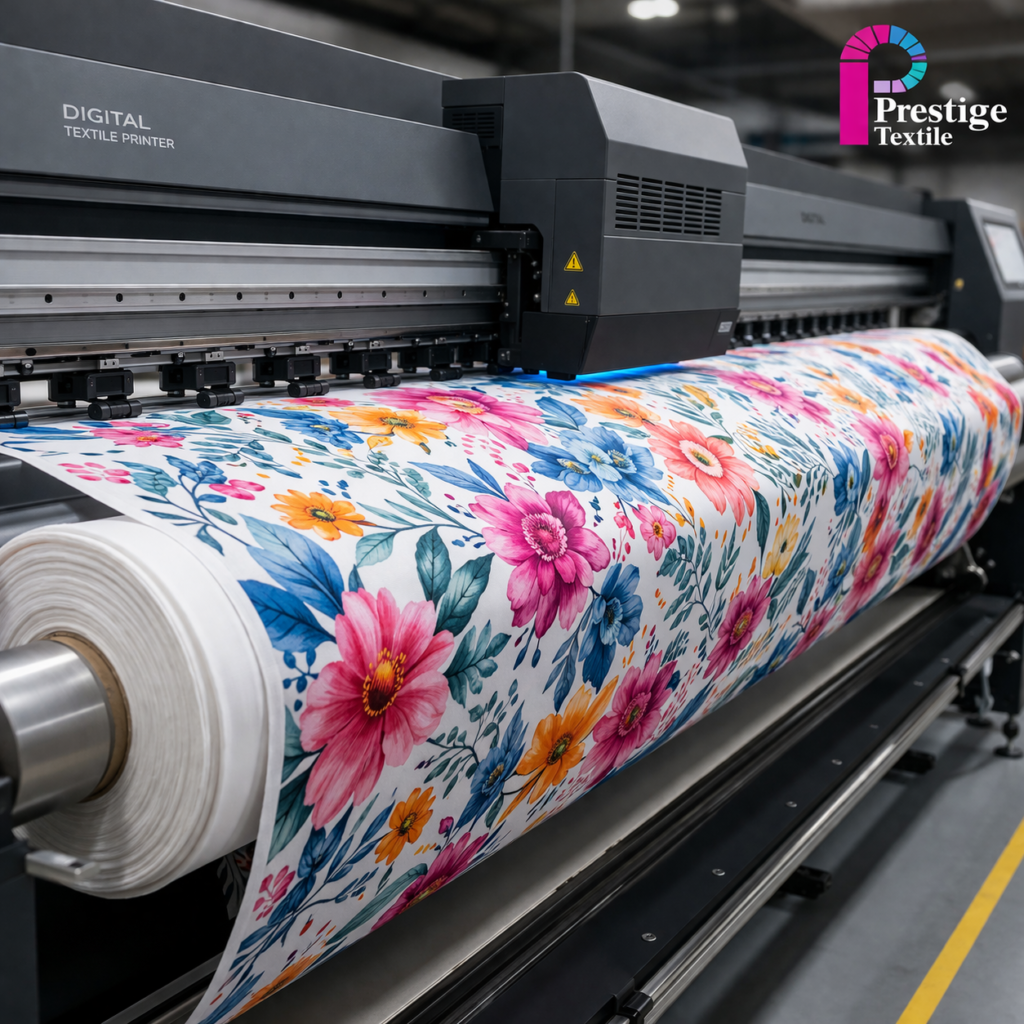
At Prestige Textiles, we’ve spent years refining what HD digital fabric printing actually means in practice not the brochure version, but the version where micron level droplet placement and ICC colour profiling combine to produce prints that match your Pantone reference within 2 Delta E units. That’s a level of colour accuracy that rotary screen printing, for all its volume advantages, structurally cannot deliver.
What “HD” Actually Means (And What Most People Get Wrong)
Walk into any fabric printer in Faisalabad or Karachi and ask about HD printing. You’ll get a confident nod. What they’re often describing, though, is a standard inkjet process running at 600 DPI — fine for basic patterns, completely inadequate for photographic sublimation or fine line geometric work at actual print quality.
True HD digital textile printing operates differently at two levels:
Resolution isn’t one number.
The meaningful specification is the combination of native print head resolution, media handling precision (how accurately the fabric moves under the head), and colour depth per channel. A printer claiming “1440 DPI” that runs on a consumer grade media transport is not the same as one delivering consistent 1200 DPI output across a 3.2metre wide industrial roll. The first is a marketing spec. The second is what shows up in your finished product.
Why Ink Chemistry Determines the Final Result.
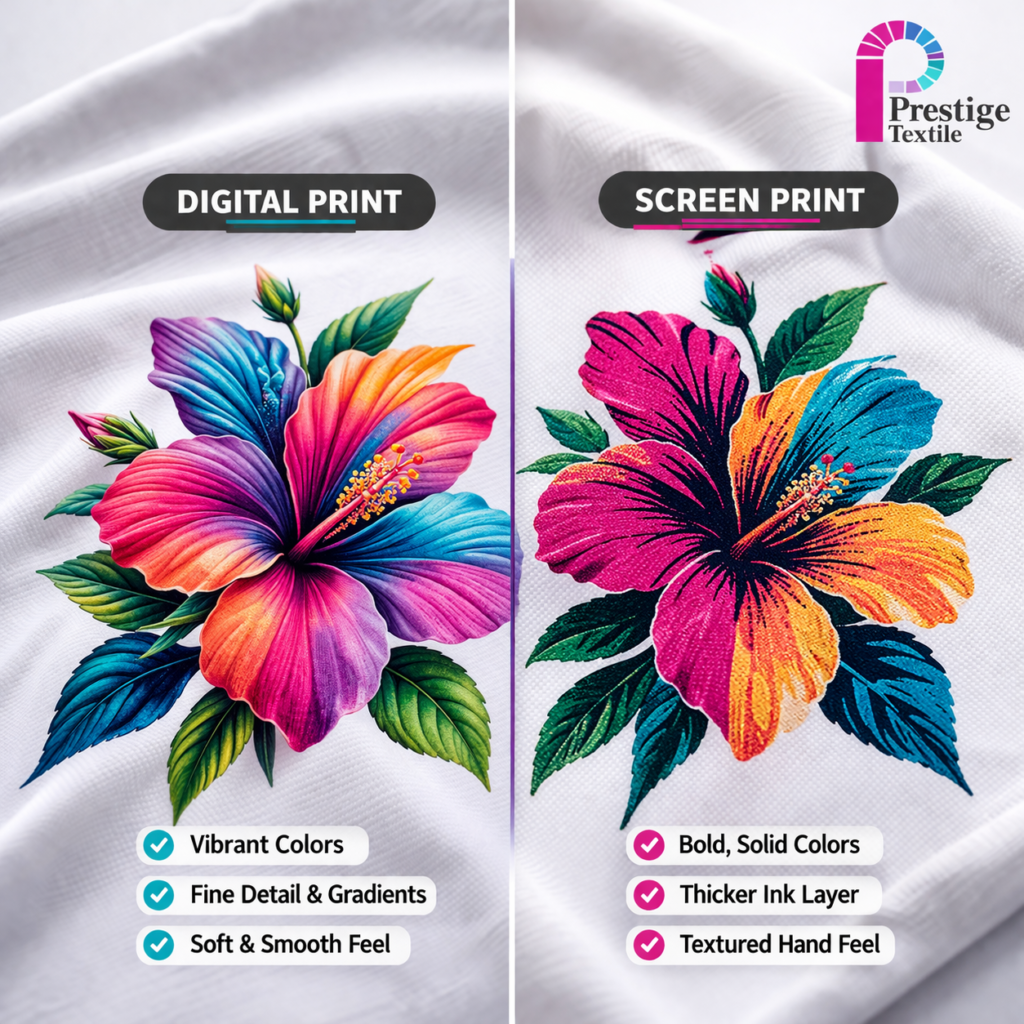
Reactive dyes behave differently from pigment systems, and sublimation transfer printing for polyester has its own colour gamut characteristics entirely. At Prestige textiles, we run separate calibrated workflows for cotton, polyester blends, silk, and synthetics because a single “universal” print profile is how you get acceptable results on everything and excellent results on nothing.
Fabrics We Print On and What That Means for Your Design
Some printers will tell you they can print on anything. That’s technically true and practically useless. Fabric weight, weave structure, and fibre content all affect ink absorption rate, colour depth, and wash fastness. A reactive dye process that produces stunning results on a 120 GSM cotton lawn will bleed into a completely different result on a 200 GSM canvas weight cotton.
Our HD printing capabilities are optimised for:
- Cotton and cotton rich blends
- (60–200 GSM) the core of Pakistan’s domestic fashion market, from lawn suits to dress shirts
- Polyester and poly blends
- via sublimation transfer essential for sportswear, performance fabric, and synthetic base home textiles
- Silk and satin
- handled with lower temperature profiles and higher resolution passes to preserve the sheen and avoid fibre damage
- Viscose and rayon
- technically demanding because of the fibre’s high absorbency; we pre-treat specifically to control dye migration
- Scuba, neoprene effect, and technical fabrics
- growing demand from Pakistan’s activewear sector, which barely existed five years ago
What we don’t claim: that every result is identical across all substrates. If you’re printing a complex photographic pattern on a slubby raw silk, we’ll tell you upfront that the texture of the fabric will become part of the print character. That’s not a flaw, it’s physics. What we can do is show you a test strike before you commit to a full run.
Pakistan’s Textile Market and the Digital Printing Shift
Pakistan produces roughly 8–9% of the world’s cotton and is among the top five global textile exporters. But for most of that history, the printing side of the industry has lagged behind the weaving and spinning sectors. Faisalabad built its reputation on yarn and greige fabric. Karachi’s garment sector grew on cut and sew volume. Digital printing, genuinely precise digital printing, arrived late.
What’s changed in 2024–26 is the demand signal, not the technology. The technology has existed for a decade. What’s changed is that Pakistan’s mid to premium fashion market lawn brands, D2C designers, export focused manufacturers — started competing on design differentiation rather than just price. You can’t differentiate on design if your print output is approximate.
From what I’ve seen operating in this market: the brands that moved toward digital printing first didn’t necessarily have bigger budgets. They had a different tolerance for compromise. They stopped accepting “close enough” on colour and started treating print quality as a brand asset.
That shift is still happening across the industry. The brands that acted on it three years ago are now running collections where the print quality is as recognisable as their silhouettes. The ones still doing full runs on rotary screens for designs that require eight or more colour separations are paying more per metre than they think they are, once rework and rejects are factored in.
No Minimums, No Screen Costs | How Small Runs Change the Maths
One of the most practical advantages of digital textile printing that rarely gets enough attention: no screens, no setup plates, no minimum runs that make small batch experimentation financially painful.
Rotary screen printing makes economic sense at scale — typically 1,000 metres and above per colourway — because the screen engraving cost amortises over volume. Below that threshold, you’re paying per unit costs that make small runs genuinely expensive.
Digital changes that equation completely. A 50metre run of a custom design costs what a 50metre run of anything costs. Which means:
- Sampling is cheap.
- Test multiple colourways before committing to a full run.
- Limited editions are viable.
- Capsule collections, seasonal exclusives, custom fabric for single order garments, none of these require minimum order negotiations.
- Design iteration happens faster.
- See a print, make a change, reprint. The cycle time is days, not weeks.
For Pakistan’s growing export and ecommerce-oriented brands, this flexibility isn’t a convenience it’s the operational model.
Washfastness: What Happens to Your Print After Washing
Wash fastness is where a lot of digital printing operations quietly underperform. The print looks stunning off the roll. After five washes, it looks like a faded poster left in a window.
The variables that determine wash fastness aren’t mysterious: ink type, fixation process, and fabric pre-treatment. Reactive dye printing on properly pre-treated cotton, followed by correct steaming and post wash fixation, achieves ISO 105 C06 ratings in the 4–5 range meaning colour loss is minimal through repeated washing. Sublimation on polyester is inherently excellent for wash fastness because the dye becomes part of the fibre structure, not a coating on top of it.
Where things go wrong is when printers skip or underinvest in fixation. Steaming time, temperature, and humidity in the fixation chamber directly affect how completely the reactive dye bonds to the cotton fibre. Cut corners here and you’re essentially printing with dye that hasn’t fully committed to the fabric.
We don’t skip that step. Every reactive dye run through our facility goes through a fully monitored steaming process. It adds time. It’s not negotiable.
Digital Textile Printing in 2026: What’s Changed and What Hasn’t
Two years ago, the conversation in Pakistan’s textile printing sector was mostly about whether digital could handle volume. Could you realistically run 5,000 metres per week? Could you maintain colour consistency across a 500metre run without visible banding or head strike variation?
Those questions are largely settled now. Industrial grade print head technology particularly from Japanese manufacturers who dominate the highend textile printer market has resolved most of the throughput and consistency objections. The current conversation has moved to:
Colour Management and ICC Profile Workflows
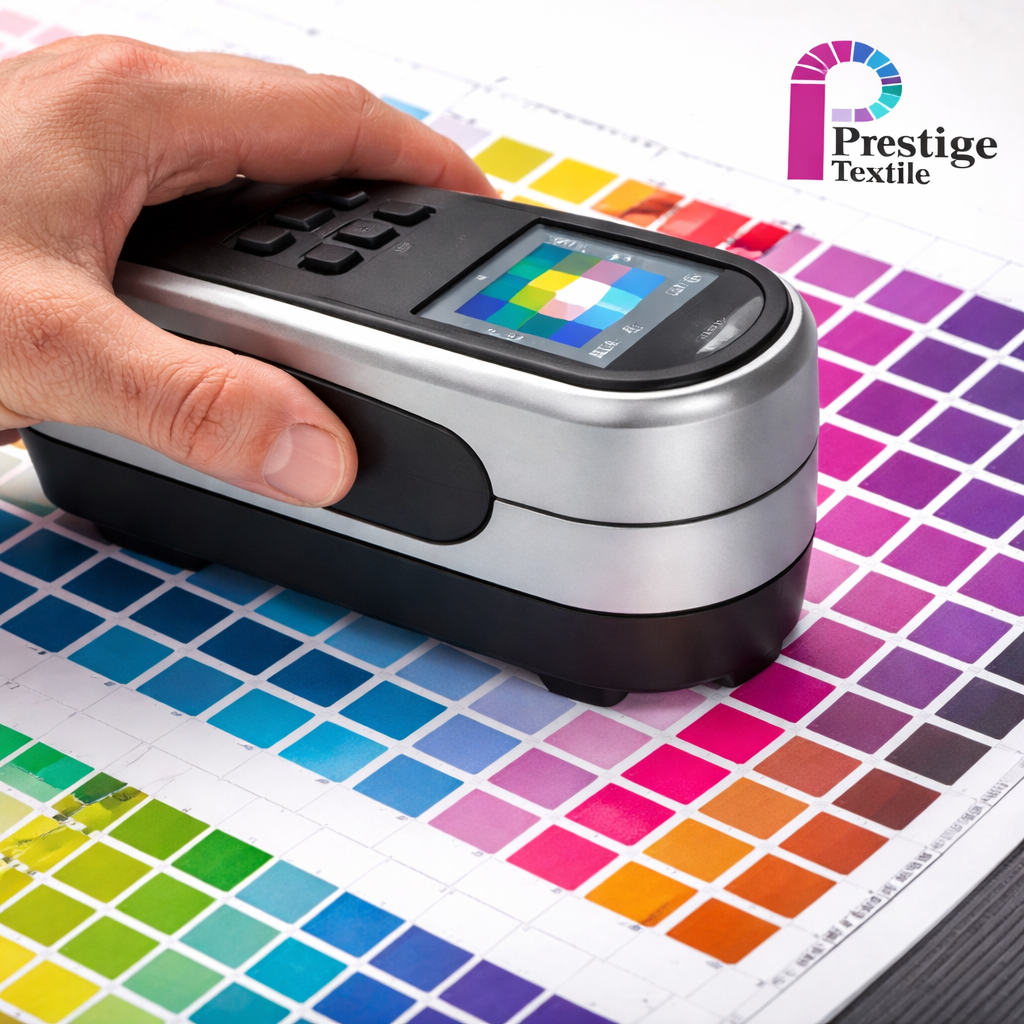
Brands now want direct file to fabric pipelines with minimal colour correction iteration. This requires investment in spectrophotometric calibration, ICC profile management, and ideally, integration between the brand’s design software and the printer’s RIP system.
Sustainable Inks and Export Compliance (OEKO-TEX, GOTS)
GOTS certified and OEKO TEX compatible inks are no longer a niche request. Export oriented brands selling into EU and US markets face buyer requirements around chemical compliance. Water based reactive and pigment systems are standard at this level.
On demand production models
This is the frontier. Print on demand fabric production for garment manufacturing where a brand orders individual metres per style rather than bulk runs is a model that digital printing makes possible but requires significant operational redesign on the printer’s side to execute efficiently.
How to Prepare Your Design Files for Digital Fabric Printing
The practical side of working with a digital printer is often more friction filled than the technology conversation suggests. File formats, colour profiles, resolution requirements, bleed specifications, these are where orders get delayed or print quality suffers.
Our process is straightforward. We accept files in PDF, AI, PSD, and TIFF formats at minimum 150 DPI at actual print size (300 DPI preferred for photographic work). Designs submitted in RGB get converted to our calibrated CMYK profiles for each substrate you’ll see a soft proof before printing if you’ve requested one, which we recommend for any design with critical colour matching.
For repeat patterns, provide the repeat tile plus specification of the repeat type (half drop, brick, straight, mirror). This is a detail that gets assumed and then argued about after the fact more than any other aspect of the process.
If your file isn’t production ready, we’ll tell you specifically what needs to change. We don’t print files we know will produce suboptimal results without flagging the issue.
The Honest Case for Not Switching to Digital
Digital textile printing isn’t always the right answer. If you’re running 50,000 metres of a four colour geometric pattern that doesn’t change season on season, rotary screen printing is faster, cheaper per metre, and more than adequate for the colour complexity involved.
Digital printing earns it keep when: your design complexity is high (eight or more effective colours, photographic elements, fine detail), your run lengths are moderate (under 2,000 metres per colourway), your timelines are tight (no weeks long screen engraving lead time), or your design programme changes frequently.
Know which category your business is in. We’re happy to tell you honestly if a traditional process would serve you better for a specific job.
FAQs
Q: Can digital textile printing match a Pantone reference we’ve been using with our screen printer for years?
The short answer: yes, with caveats. Digital printing can match Pantone references within 2–3 Delta E units on calibrated workflows — which is closer than most screen printers achieve across a long run. The caveat is that the visual appearance of a colour depends on the fabric surface as much as the ink. The same Pantone on a matte cotton poplin will look different from the same Pantone on a satin weave, simply because light reflection changes perceived colour. We recommend printing a test strike on your actual fabric before approving any critical colour match.
Q: We’ve had bad experiences with digital print wash fastness before. What’s different about your process?
Most wash fastness failures in digital printing trace back to one of three issues: wrong ink type for the substrate, inadequate fixation time/temperature, or skipped or insufficient post wash neutralisation. We run substrate specific ink systems, our steaming process is fully monitored with logged parameters for every run, and our post wash line includes proper neutralisation and softening stages. If you’ve had consistent wash fastness problems with a previous supplier, we’d suggest running an ISO 105 C06 test on a sample run before committing to full production — we can help facilitate that.
Start with a Sample Run
The best argument for our HD digital printing capability isn’t this page. It’s a finished metre of your actual design on your actual fabric, held in your hands.
We offer test runs for new clients a practical step before committing to full production. Bring your design files, specify your fabric substrate, tell us what you’re trying to achieve, and we’ll produce something you can evaluate against your standards rather than our claims.
If the quality matches what you need, we’ll talk about scale and pricing. If it doesn’t, you’ll have spent a fraction of a full run to find out which is exactly how sampling should work.
Contact Prestige Textiles to request your sample run or discuss your print requirements with our technical team.